Delinquent
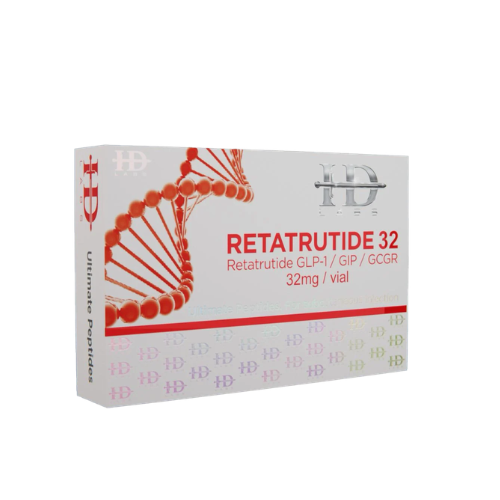
HD Labs Retatrutide 32 Vial
HD Labs Retatrutide 32 Vial
Couldn't load pickup availability
- Retatrutide is an unregistered triple-agonist peptide (GLP-1/GIP/glucagon) sold in South Africa as a 32mg lyophilised vial requiring reconstitution with bacteriostatic water.
- The 2023 NEJM Phase 2 trial reported 24.2% mean weight loss at 48 weeks on the 12mg weekly dose—the highest published figure for any obesity peptide to date.
- Titration follows a four-week stepwise protocol: 2mg weeks 1–4, 4mg weeks 5–8, 6mg weeks 9–12, with optional escalation to 12mg under prescriber supervision.
- Vial format costs 15–25% less per milligram than the pre-filled pen but requires sterile reconstitution technique.
- Retatrutide is not SAHPRA-registered and is accessible only via Section 21 prescriber routes in South Africa.
- GI side effects (nausea, vomiting, diarrhoea) peak during dose escalation and typically settle within 1–2 weeks at a stable dose.
What Is HD Labs Retatrutide 32mg?
HD Labs Retatrutide 32mg is a South African-compounded vial of retatrutide (Eli Lilly and Company investigational code LY3437943), a single peptide molecule that simultaneously activates three metabolic receptors: GLP-1 (Glucagon-Like Peptide-1), GIP (Glucose-dependent Insulinotropic Polypeptide), and glucagon [13]. HD Labs sells it in 32mg lyophilised vials for reconstitution, and it is not registered with SAHPRA or approved by the FDA (Food and Drug Administration) or EMA (European Medicines Agency) as of early 2026 [1][9][11].
The triple-agonist mechanism separates it from earlier injectables because each receptor pathway controls a distinct metabolic lever:
- GLP-1 receptor agonist activity — slows gastric emptying and suppresses appetite, the same axis semaglutide acts on to reduce caloric intake.
- GIP receptor agonist activity — improves insulin sensitivity and reduces insulin resistance, the second axis tirzepatide adds to enhance glucose handling and reduce hepatic fat.
- Glucagon receptor agonist activity — increases resting energy expenditure via thermogenesis, a third lever neither semaglutide nor tirzepatide pulls, which raises baseline calorie burn independent of appetite suppression.
That third receptor is why the 2023 NEJM Phase 2 trial (Jastreboff et al.) recorded a mean 24.2% body weight reduction at 48 weeks on the 12mg weekly dose, the highest figure published for any obesity peptide to date [13].
Triple Agonist vs Dual vs Single: Clinical Outcomes Compared
Retatrutide produced the largest mean weight loss of the three leading obesity peptides in Phase 2 trials, but no head-to-head RCT (Randomized Controlled Trial) exists as of 2026, so the figures below come from separate trials with different durations and populations.
Glucagon receptor agonism raises resting energy expenditure by stimulating hepatic glucose output and mitochondrial activity — a thermogenesis effect that semaglutide does not produce because it lacks glucagon signalling. Tirzepatide’s GIP arm improves insulin sensitivity and adipocyte lipid handling, but neither GLP-1 nor GIP directly increases calorie burn at rest. Adding glucagon agonism is the mechanistic reason retatrutide’s Phase 2 curve was still trending downward at week 48 without a clear plateau [3], suggesting continued weight loss beyond the trial endpoint.
Why these numbers are not a clean comparison
The 24.2% vs 22.5% vs 14.9% framing is cross-trial, and the durations diverge meaningfully. Retatrutide’s 48-week figure was measured 20 to 24 weeks earlier in the treatment arc than the SURMOUNT-1 and STEP 1 endpoints. Weight-loss curves for incretin therapies typically continue downward past week 48. A fair retatrutide-vs-tirzepatide comparison at matched 72-week timepoints does not exist in the published literature as of early 2026 because the Phase 2 trial stopped at 48 weeks, and TRIUMPH Phase 3 readouts are still pending [4][5].
Baseline populations also differ: STEP 1 enrolled BMI ≥30 (or ≥27 with comorbidity) non-diabetics, SURMOUNT-1 used similar criteria, and the 2023 Jastreboff retatrutide trial enrolled adults with BMI ≥30 or ≥27 with weight-related comorbidity. Subgroup sizes, ethnic composition, and run-in protocols all vary, so the trial cohorts are not directly comparable.
Retatrutide Dosage Instructions: Full Titration Schedule
The HD Labs Retatrutide 32mg titration schedule mirrors the 2023 NEJM Phase 2 protocol: start at 2mg subcutaneously once weekly for four weeks, escalate to 4mg weekly for weeks 5–8, then move to 6mg weekly from week 9 onward if tolerance allows [12]. Retatrutide’s 5–7 day half-life supports once-weekly dosing because steady-state plasma concentrations remain stable across the injection interval.
Weeks 1–4: 2mg subcutaneous injection once weekly. Most GI side effects (nausea, mild reflux, transient appetite suppression overshoot) emerge in this window because the GLP-1 and GIP receptors are newly activated.
Weeks 5–8: 4mg SC once weekly if week 4 was tolerated without persistent vomiting or volume depletion. Hold the dose another two weeks if side effects are still active — receptor downregulation takes time.
Weeks 9–12: 6mg SC once weekly based on weight-loss response and tolerability. Some users hold at 4mg if appetite suppression is already adequate and further escalation risks unmanageable nausea.
Week 13+: Continue at the lowest effective dose. Jastreboff et al. (2023) used up to 12mg weekly in the Phase 2 trial, but escalation beyond 6mg should only happen under prescriber supervision [12] because real-world safety data at higher doses remain limited.
Why slow titration matters
Stepwise dose increases allow GLP-1, GIP, and glucagon receptors to downregulate progressively. This is why gradual escalation cuts nausea and vomiting rates compared with starting at therapeutic doses. The 2023 Phase 2 trial used four-week dose steps for this reason [12]. Clinic-reported data show that jumping from 2mg straight to 8mg is the single most common cause of treatment dropout in incretin peptide therapy [1].
Injection site rotation
Inject subcutaneously into the abdomen (avoiding a 5cm radius around the navel), outer thigh, or back of the upper arm. Rotate sites each week to prevent lipohypertrophy and erratic absorption — repeated injections in the same spot can create scar tissue that alters drug uptake. A 32mg vial yields roughly 16 weeks at 2mg, 8 weeks at 4mg, or 5 weeks at 6mg weekly, before accounting for reconstitution losses.
Share