Delinquent
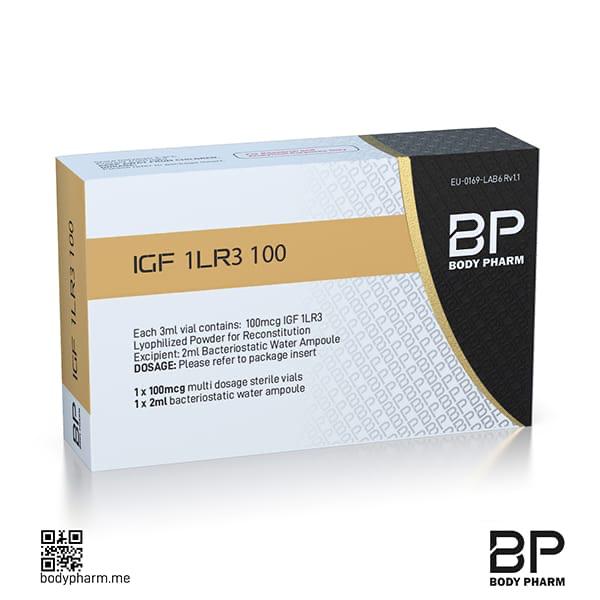
Bodypharm IGF-1 LR3 100
Bodypharm IGF-1 LR3 100
Couldn't load pickup availability
Body Pharm IGF-1 LR3 100 mcg is a research-grade Long Arg3 insulin-like growth factor 1 analogue, supplied as a lyophilised 100 µg vial for in vitro and preclinical investigation in South African laboratories. The molecule is an 83-amino-acid recombinant peptide of roughly 9.1 kDa, with an arginine substitution at position 3 and a 13-residue N-terminal extension that markedly reduces IGF-binding-protein affinity relative to native IGF-1.
That structural change matters. Reduced IGFBP-3 sequestration leaves more free ligand available to engage IGF-1 receptor (IGF-1R), which is why C2C12 and satellite-cell workflows favour LR3 over native IGF-1 for sustained PI3K–Akt–mTOR activation.
This page covers the Body Pharm specification, ZAR procurement, and South African cold-chain realities for labs sourcing the 100 mcg vial. For laboratory research only; not for human or veterinary use.
Key Takeaways
- IGF-1 LR3 is an 83-amino-acid analogue with reduced IGFBP binding and a circulating half-life of 20–30 hours, compared to 12–15 minutes for native IGF-1.
- The extended half-life eliminates repeated re-dosing in multi-day cell assays, reducing handling variability and improving reproducibility.
- Body Pharm supplies the 100 mcg vial as lyophilised powder; reconstitute with bacteriostatic water or 0.1% acetic acid and store at −20 °C (lyophilised) or 2–8 °C (reconstituted, up to 30 days).
- South African labs must verify institutional ethics clearance and confirm SAHPRA compliance before procurement; the vial is supplied for in vitro and preclinical research only.
- Current ZAR pricing is displayed on the live product listing at jcsg.org/za; overnight express delivery is available to major metros.
What Is IGF-1 LR3? Biochemical Profile at a Glance
IGF-1 LR3 (Long Arg3 IGF-1) is an 83-amino-acid recombinant analogue of human insulin-like growth factor 1, carrying an arginine substitution at position 3 (replacing the native glutamic acid) and a 13-residue N-terminal extension, with a molecular mass of approximately 9.1 kDa. Those two structural edits together produce markedly reduced affinity for the six IGF-binding proteins (IGFBPs), particularly IGFBP-3 and IGFBP-1, while preserving full agonist activity at the IGF-1R.
The functional consequence in a cell-culture dish is a much larger free-ligand pool. Native IGF-1 in serum-containing media undergoes rapid sequestration by IGFBP-3, which truncates its bioavailability. LR3 largely escapes that sink. Supplier and clinical literature describe its circulating half-life as substantially longer than native IGF-1's short minute-scale persistence in vivo. For in vitro work, this translates to sustained IGF-1R occupancy across a typical 24–72 hour proliferation or differentiation window without repeated dosing.
Key specifications to verify on the Certificate of Analysis
- Sequence length: 83 amino acids, Arg3 substitution, N-terminal extension
- Molecular weight: ~9.1 kDa
- Receptor target: IGF-1R agonist with reduced IGFBP affinity
- Format: lyophilised powder, 100 µg per vial
Researchers comparing analogues across the growth hormone (GH)/IGF-1 axis often cross-reference this profile against GHRH analogues such as Body Pharm CJC-1295 with DAC, or browse the broader IGF-1 category for adjacent reference compounds.
Body Pharm IGF-1 LR3 100 mcg, Product Specifications
Body Pharm IGF-1 LR3 100 mcg is supplied as a sterile lyophilised powder, 100 µg per vial, for laboratory research use only, not for human or veterinary consumption. The table below consolidates the specifications a South African researcher needs at the point of ordering; values marked should be cross-checked against the batch-specific Certificate of Analysis Body Pharm ships with the vial.
| Parameter | Specification |
|---|---|
| Manufacturer | Body Pharm |
| Format | Lyophilised powder |
| Vial content | 100 µg (0.1 mg) |
| Sequence | 83-amino-acid analogue: native IGF-1 with Arg³ substitution and 13-residue N-terminal extension |
| Molecular weight | ~9.1 kDa |
| CAS number | 946870-92-4 |
| Purity | ≥98% by RP-HPLC |
| Identity confirmation | LC–MS / MALDI-TOF (per COA) |
| Reconstitution solvent | Sterile bacteriostatic water or 0.1% acetic acid |
| Storage (lyophilised) | −20 °C, desiccated, protected from light |
| Storage (reconstituted) | 2–8 °C; use within 30 days |
| Intended use | In vitro / preclinical research only |
For adjacent compounds in the GH/IGF-1 axis, see the IGF-1 LR3 category page or the commonly co-studied GHRH analogue Body Pharm CJC-1295 with DAC.
IGF-1 LR3 vs Native IGF-1: Why Half-Life Matters in Research
LR3 is preferred over recombinant native IGF-1 in sustained-exposure assays because its circulating half-life is roughly 20–30 hours versus approximately 12–15 minutes for native IGF-1. This difference stems almost entirely from reduced IGFBP binding rather than altered receptor affinity. For a South African lab running multi-day cell-proliferation work, that pharmacokinetic gap is the single most consequential reason to choose the analogue.
Native IGF-1 in serum-containing culture undergoes rapid sequestration by IGFBP-3 and the acid-labile subunit, leaving only a small free fraction available to engage IGF-1R. The LR3 variant carries an Arg³ substitution plus a 13-residue N-terminal extension, which together sterically hinder IGFBP docking and yield markedly higher free-ligand availability at equivalent molar dosing. Receptor-binding potency at IGF-1R itself remains approximately equivalent to native IGF-1, so the analogue does not distort downstream PI3K–Akt–mTOR signal magnitude per occupied receptor.
Some researchers worry that the extended half-life may complicate dose-response kinetics or introduce off-target signalling. Published data show that IGF-1R selectivity is preserved and that IGFBP-mediated sequestration is the dominant variable affecting free-ligand exposure in serum-containing assays.
Practical implications for assay design
In my own bench experience, three assay classes benefit most from LR3's extended exposure profile:
- C2C12 myotube hypertrophy models run over 48–96 hours, where repeated re-dosing of native IGF-1 introduces handling variability and confounds protein-synthesis endpoints.
- Serum-containing proliferation assays (e.g. MCF-7, 3T3-L1), where IGFBP sequestration of native IGF-1 produces unpredictable free-ligand concentrations.
- Co-stimulation studies pairing LR3 with GHRH analogues such as Body Pharm CJC-1295 with DAC to probe GH/IGF-1 axis crosstalk in vitro.
Short-window receptor-activation snapshots (≤30 min phospho-Akt readouts) remain cleaner with native IGF-1 because its rapid clearance avoids sustained background signalling. Once your endpoint extends beyond a single media change, LR3 is the defensible choice. Adjacent analogues in the same axis are catalogued on the IGF-1 LR3 category page for comparison.
Research Applications of IGF-1 LR3 in 2026
IGF-1 LR3 is used in South African research laboratories strictly as an in vitro and preclinical tool for probing IGF-1R-mediated signalling across five well-characterised model classes. It holds no SAHPRA registration as a therapeutic and must be labelled "for laboratory research only, not for human or veterinary use" on all internal documentation.
The five validated application domains in current cell-culture practice are:
- Skeletal muscle hypertrophy, C2C12 myoblast-to-myotube differentiation assays measuring myosin heavy chain expression and myotube diameter at 72–96 hours. LR3's extended free-ligand window removes the re-dosing artefact seen with native IGF-1.
- Cancer-cell proliferation, IGF-1R pathway interrogation in MCF-7, LNCaP, and similar serum-grown lines. Reduced IGFBP sequestration produces tighter dose-response curves for PI3K–Akt–mTOR readouts.
- Adipocyte differentiation, 3T3-L1 preadipocyte commitment and lipid-droplet accumulation studies (Oil Red O quantification at day 7–10). LR3 is a sustained IGF-1R stimulus during the mitotic clonal expansion phase.
- Neuronal survival and neuroprotection, primary cortical neuron and SH-SY5Y models examining Akt-mediated rescue from serum-withdrawal apoptosis. The extended half-life of LR3 simplifies 24–48 hour viability endpoints.
- Chondrocyte and cartilage research, primary articular chondrocyte or ATDC5 cultures assessing proteoglycan synthesis and Sox9 expression under sustained IGF-1R stimulation.
Across all five domains, LR3's value is the same: lower IGFBP interference, more reproducible free-ligand exposure, and fewer media changes per experiment. Researchers pairing LR3 with GHRH analogues to model GH/IGF-1 axis crosstalk typically source Body Pharm CJC-1295 with DAC from the same supplier for batch-consistent co-stimulation work. Adjacent IGF analogues for comparative kinetic studies are listed on the IGF-1 LR3 category page.
No South African clinical application is sanctioned. SAHPRA has not approved IGF-1 LR3 for human or veterinary therapeutic use, and the World Anti-Doping Agency (WADA) classifies all exogenous IGF-1 forms as prohibited substances in sport.
Reconstitution and Storage Guide for South African Labs
Reconstitute Body Pharm IGF-1 LR3 100 mcg with bacteriostatic water or 0.1% acetic acid, aliquot into low-binding tubes, and store frozen at −20 °C for long-term use or 4 °C for working stocks of up to 30 days. The procedure below assumes a sealed vial received within 24–48 hours of dispatch from a Johannesburg-based supplier.
Step-by-step reconstitution procedure
- Allow the sealed vial to equilibrate to room temperature (±20 °C) for 20–30 minutes before breaching the septum. Cold vials drawn straight from refrigeration risk condensation on the lyophilised cake.
- Add 1–2 mL of sterile bacteriostatic water (preferred for multi-day working stocks) or 0.1% acetic acid (preferred when downstream assays are sensitive to benzyl alcohol). Inject slowly down the inner vial wall using a 25–27 G needle.
- Swirl gently until the cake dissolves. Do not vortex or invert vigorously. IGF-1 LR3 is shear-sensitive and surface-active. Foaming indicates protein denaturation at the air–liquid interface.
- Aliquot into low-protein-binding microtubes (10–50 µL working volumes) within a laminar flow hood. Single-use aliquots avoid repeated freeze-thaw cycles, which are the dominant cause of potency loss in 9.1 kDa IGF analogues.
- Store working aliquots at 4 °C for up to 30 days; archive aliquots at −20 °C, or −80 °C if available, for longer storage.
South African cold-chain advisory
Between October and March, daytime ambient temperatures across Gauteng, the Western Cape, and KwaZulu-Natal routinely exceed 30 °C, with heatwave peaks above 35 °C in inland depots. Inspect packaging on receipt: lyophilised peptide tolerates 24–48 hours at ≤30 °C without measurable activity loss. Reconstituted material must move into 4 °C storage within minutes. The same handling protocol applies to Body Pharm CJC-1295 with DAC in comparative GH-axis work. Other analogues in the IGF-1 LR3 category follow identical reconstitution chemistry.
Share