Delinquent
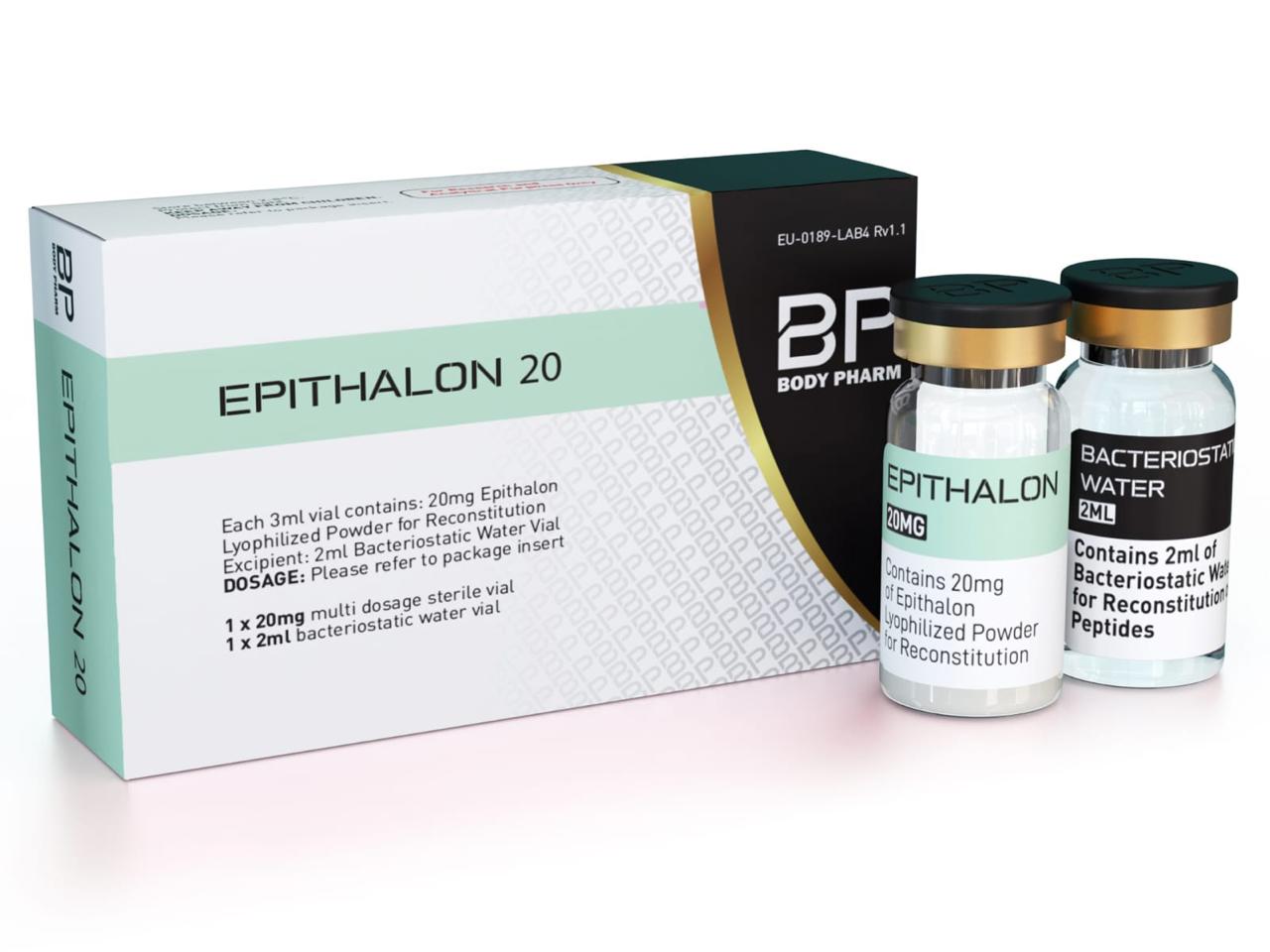
Bodypharm EPITHALON 20mg Vial
Bodypharm EPITHALON 20mg Vial
Couldn't load pickup availability
Body Pharm Epithalon 20mg is a lyophilised synthetic tetrapeptide (Ala-Glu-Asp-Gly, molecular weight 390.4 Da) sold in South Africa for in vitro and preclinical research, with local listings appearing through resellers such as Syntrix Labs rather than a single manufacturer storefront. Researchers procuring in 2026 should request a batch-specific certificate of analysis directly, since neither Syntrix Labs nor Body Pharm's public channels publish HPLC purity figures on the product page. Purity directly affects the reliability of your experimental results and the cost-per-unit of active compound.
This guide consolidates verified sequence data, reconstitution arithmetic (20 mg in 2 mL gives 10 mg/mL), SAHPRA scheduling context, and the current state of the telomerase and circadian literature. By the end, you'll have a clear picture of the peptide's chemical identity, the preclinical evidence for telomerase and circadian effects, current South African pricing and regulatory requirements, and how to evaluate a 20 mg vial against your actual research needs before committing ZAR to an order.
Key Takeaways
- Body Pharm Epithalon 20 mg is a synthetic tetrapeptide (Ala-Glu-Asp-Gly) supplied as lyophilised powder for laboratory research only, not human use.
- Preclinical evidence supports telomerase activation and circadian regulation in cell and rodent models; no completed human clinical trials exist as of 2026.
- Request batch-specific certificates of analysis before purchase, as HPLC purity data are not publicly listed.
- Epithalon is not individually scheduled under South African medicines law; human administration would require SAHPRA clinical trial authorisation.
- Reconstitution in 2 mL yields 10 mg/mL; store lyophilised stock at −20 °C and reconstituted aliquots at 2–8 °C for up to 30 days.
What Is Body Pharm Epithalon 20 mg?
Body Pharm Epithalon 20 mg is a lyophilised synthetic tetrapeptide vial supplied for in vitro and preclinical research. It contains 20 mg of Ala-Glu-Asp-Gly (CAS 307297-39-8) with an average molecular weight of approximately 390.35 g/mol. Body Pharm is the listed manufacturer, with South African distribution through resellers including Syntrix Labs and Yaga marketplace listings.
The peptide is a synthetic short-chain analogue derived from epithalamin, a polypeptide fraction originally isolated from the pineal gland. This is why "Epithalon" and "Epitalon" appear interchangeably in the literature and on vendor pages. The synthetic route delivers batch-to-batch consistency that tissue extracts cannot match.
Quick identity reference
| Attribute | Value |
|---|---|
| Manufacturer | Body Pharm |
| Format | Lyophilised powder, single vial |
| Vial size | 20 mg |
| Sequence | Ala-Glu-Asp-Gly |
| Molecular weight | ~390.35 g/mol |
| CAS number | 307297-39-8 |
| Status | Research use only; not registered with SAHPRA as a medicine |
Epithalon Sequence & Structural Properties
Epithalon is the linear tetrapeptide H-Ala-Glu-Asp-Gly-OH (one-letter: AEDG; three-letter: Ala-Glu-Asp-Gly), with a free N-terminal α-amino group on alanine and a free C-terminal carboxyl on glycine. The average molecular weight is 390.4 Da to four significant figures. Peptide bonds run conventionally N→C: Ala¹–Glu²–Asp³–Gly⁴.
The two acidic side chains (γ-carboxyl of Glu, β-carboxyl of Asp) give the molecule a net negative charge at physiological pH, which influences how it interacts with cell membranes and receptor proteins.
The sequence is short, hydrophilic, and lacks disulfide bridges or aromatic residues. Reconstitution in aqueous buffer at neutral pH is straightforward. Sterile water or 0.9% sodium chloride is the standard solvent for in vitro work, with 0.22 μm filtration before cell-culture use. Lyophilised vials should be stored desiccated at −20 °C, with working aliquots prepared to avoid repeated freeze-thaw cycles that accelerate peptide bond hydrolysis.
Specification summary
| Property | Value |
|---|---|
| IUPAC short form | H-Ala-Glu-Asp-Gly-OH |
| One-letter code | AEDG |
| CAS | 307297-39-8 |
| Average MW | 390.4 Da |
| Solubility | Aqueous buffer, pH ~7 |
| Storage | −20 °C, desiccated, sealed |
| Shelf life (sealed, lyophilised) | ~24 months |
Telomerase Research: What the Studies Show
The preclinical case for Epithalon rests on three mechanistic areas: telomerase activation in somatic cells, lifespan extension in rodent models, and circadian regulation through pineal melatonin pathways. All published evidence as of 2026 remains preclinical; no completed human clinical trials of Epithalon are indexed in mainstream databases between 2023 and 2026. Preclinical findings do not reliably translate to human efficacy or safety, and researchers should treat these results as hypothesis-generating rather than proof of clinical benefit.
Khavinson and colleagues (Bull Exp Biol Med, 2003) reported that Ala-Glu-Asp-Gly induced telomerase activity in cultured human somatic cells and lengthened telomeres beyond the Hayflick limit, framing the peptide as a candidate modulator of replicative senescence. The work was conducted in fibroblast cultures and has not been replicated at scale by independent Western laboratories, a gap worth keeping in mind when designing experiments around these claims.
Anisimov et al. (J Gerontol A Biol Sci Med Sci, 2011 and earlier rodent cohorts) observed increased mean lifespan and reduced spontaneous tumour incidence in CBA mice and rats receiving chronic low-dose Epithalon. Effects were attributed in part to restoration of nocturnal melatonin amplitude in aged animals. The circadian arm of the literature centres on pineal gland signalling. Rodent and small human cohort data describe upregulation of melatonin synthesis and resynchronisation of cortisol rhythm, alongside IL-2 mRNA induction in immune tissues. These observations point to a neuroendocrine mechanism, though human relevance remains unproven.
A 2026 evidence overview aimed at practitioners synthesises these mechanistic strands and explicitly notes the gap: telomerase, melatonin, and immune-signalling data are dominated by cell and rodent models plus small, older human cohorts. No large controlled trials and no long-term safety follow-up have been published in the 2023–2026 window. Epithalon should be evaluated as an investigational tetrapeptide with a coherent but unfinished mechanistic dossier, suitable for in vitro and preclinical research designs rather than translational endpoints.
Epithalon (Ala-Glu-Asp-Gly) is the synthetic tetrapeptide analogue of epithalamin, a polypeptide complex originally isolated from bovine pineal gland extract and characterised in Anisimov's rodent ageing programme. The synthetic form was developed to reproduce epithalamin's neuroendocrine signalling in a defined, reproducible sequence suitable for controlled laboratory work, removing the lot-to-lot variability inherent to tissue extracts.
The proposed mechanism in preclinical models runs upstream of melatonin itself. Epithalon appears to act on pinealocytes to upregulate endogenous melatonin synthesis and restore nocturnal amplitude in aged animals, with downstream effects on hypothalamic-pituitary axis signalling and the antioxidant cascade attributed to melatonin's free-radical scavenging activity. This is mechanistically distinct from exogenous melatonin administration, which bypasses pineal regulation entirely and delivers a pharmacological bolus rather than modulating the gland's own output rhythm. That distinction matters: it suggests a different pathway of action and potentially different biological outcomes, which is worth building into your experimental design.
Share